

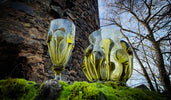
Legacy in Light: The Story of Czech Glass
, by Lucie Kabova, 5 min reading time
, by Lucie Kabova, 5 min reading time
Published by Domus Artis
Welcome to the first chapter of our ongoing series exploring the rich heritage of Czech glassmaking. From its historic roots and visionary schools to the sculptural innovations that shaped modern art. Each week, we’ll uncover a new facet of this extraordinary story - the artists, techniques, and timeless beauty that continue to define the Czech Republic’s global reputation for glass artistry.
Follow the journey, and discover how history, craftsmanship, and light come together to create a true Legacy in Light.
The story of Czech glass begins deep in the forests of Bohemia over eight centuries ago - a story where wood, fire, and human imagination forged a craft that would one day become fine art.
The earliest Czech glassworks emerged in the 13th and 14th centuries, hidden among the beech forests of Bohemia: in Bohemian Forest and Ore Mountains (Erzgebirge). The dense woods provided everything a glassmaker needed: wood for the furnaces and potash from the beech ashes, a natural flux that allowed sand to melt at far lower temperatures. From every 100 kg of ash, roughly 13 kg of potash could be obtained, an exhausting process that meant each glassworks survived only as long as the nearby forest did.
The result was the distinctive “forest glass” (in Czech: lesní sklo), a slightly greenish or yellow-tinged material caused by iron impurities in the sand. Far from being a flaw, this colour became the hallmark of medieval glass in Central Europe.

The reign of Charles IV (1346–1378) marked a turning point. Educated in France and Italy, the emperor sought to raise Bohemia to the level of Western Europe’s great cultural centers. He invited master craftsmen from Venice, France, and Germany, among them glassmakers who helped create the stained-glass windows of St Vitus Cathedral in Prague. Because importing finished glass was costly and impractical, Bohemian artisans collaborated closely with their foreign counterparts, learning advanced techniques and establishing the foundation for an independent glass tradition.
In the Middle Ages, glass was still a luxury reserved for the wealthy. Bowls, goblets, and jugs from glass adorned the tables of nobles and clergy only. Most common people still used wooden or clay utensils, or ate from shared trenchers (flat pieces of bread or wood).
However, even among the upper classes, meals were often eaten with hands, since forks did not become common in Central Europe until the 16th–17th century. To prevent slipping from greasy fingers, vessels were decorated with raised glass “dots” - a Gothic hallmark born from practicality. Some glasses even bore measuring marks to ensure fair drinking during contracts or feasts, where each guest had to consume an identical portion, an elegant ritual of trust in glass.
Inventive designs also appeared, such as the “riding bottle”, whose clever shape slowed the flow of liquid, allowing riders to drink without spilling. Centuries later, during the Romantic revival, these forms returned as curiosities known as “joke jars”.

Bohemian glassmakers proved both practical and inventive, but history was not always kind. The Hussite Wars in the 15th century brought widespread destruction and halted production. As peace returned under the Jagiellonian dynasty (1471–1526), new Renaissance influences arrived, and demand for Venetian-style glass grew. Yet importing it from Italy was expensive and risky, fragile blown glass rarely survived long journeys over bumpy medieval roads. Necessity once again drove innovation: Bohemian glassworks began producing their own Venetian-type glass locally, blending Italian finesse with regional craftsmanship (Bohemian glassmakers began experimenting with Venetian techniques, particularly blown soda-lime glass, and adapted them using local materials and traditions).

By the late Middle Ages, glassmaking had become an integral part of Bohemian culture. Whether as stained glass in cathedrals or green forest glass in noble halls, it reflected the union of nature, science, and artistry. These early workshops, fueled by wood, faith, and skill, laid the foundations for what would, centuries later, evolve into Bohemian crystal and, eventually, the world-renowned Czech school of sculptural and optical glass.
The story of Czech glass begins not in the modern studio, but in the forest furnace: where art was first born from ash and light.


