

Legacy in Light: The Story of Czech Glass – Part 4
, by Lucie Kabova, 15 min reading time
, by Lucie Kabova, 15 min reading time
Published by Lucie Aboegla, Domus Artis
Welcome to the fourth chapter of our ongoing series exploring the rich heritage of Czech glassmaking. From its historic roots and visionary schools to the sculptural innovations that shaped modern art. Each week, we’ll uncover a new facet of this extraordinary story - the artists, techniques, and timeless beauty that continue to define the Czech Republic’s global reputation for glass artistry.
Follow the journey, and discover how history, craftsmanship, and light come together to create a true Legacy in Light.
The first half of the nineteenth century represents one of the most intellectually and technically fertile periods in the history of Czech (Bohemian) glassmaking. Emerging from the decline of late Baroque ornamentation and challenged by the growing dominance of English lead crystal at the turn of the century, Bohemian glassmakers did not retreat into imitation for long. Instead, they responded with a wave of technical experimentation, chromatic innovation, and stylistic refinement that would reassert Bohemia as a global centre of luxury glass production by the 1830s and 1840s.
This period unfolds across three major stylistic movements - Classicism and Empire, Biedermeier, and Rococo Revival/Historicism, each supported by remarkable advances in glass chemistry, colouring techniques, cutting methods, and decorative practices. What distinguishes Czech glassmaking in this era is the continuity between tradition and innovation: while forms and decoration changed according to broader European taste, the mastery of material and technical invention remained distinctly Bohemian.

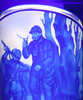
1. Beaker with the Deposition from the Cross Dominik Biemann (signed), Franzensbad or Prague, glass Glasswork of Count Harrach, circa 1829, source: https://www.sklosteigl.cz/ 2. Bohemian crystal glass made in the mid-19th century by the historic Fredrich Egermann manufactory, source: https://www.passioneantiqua.com/ 3. An elegant Bohemian cut crystal goblet etched with noble stags, 19th century, source: https://rauantiques.com/ 4. Colorless glass with amber overlay, partially gilt, Chinese circus performers in gold and silver around the rim, Friedrich Egermann, Šlukov 1777–1864 Novy Bor, source: https://www.invaluable.com/
At the beginning of the nineteenth century, Bohemian glass stood at a stylistic crossroads. The elaborate engraved Baroque vessels of the eighteenth century had lost their market appeal, and the Napoleonic Wars further disrupted trade and production. English cut lead crystal dominated European taste, admired for its brilliance and weight. Bohemian glassmakers initially attempted to imitate these foreign patterns, but this phase proved short-lived.
Instead, under the influence of Classicism and the Napoleonic Empire style, Bohemian glass adopted simpler, more monumental, and architecturally structured forms. Colourless glass predominated during this period, decorated primarily with refined ornamental or figural engraving. The aesthetic language drew inspiration from the antique world, reflecting the broader Neo-Classical movement in European art. Slender flutes, beaker forms, and restrained geometric compositions replaced Baroque exuberance.
During this period, Bohemian glassmakers began adapting their traditional potash-lime composition in response to English lead crystal, striving to achieve greater brilliance and weight. Engraving flourished as a primary decorative medium.
This period laid the technical and artistic foundation for what would follow. It was a bridge between the engraved clarity of Classicism and the chromatic explosion of the Biedermeier era.

Engraved beaker, attributed to Hieronymus Hackel and produced in North Bohemia or Lower Styria around 1803–10, exemplifies the Classicist phase of early nineteenth-century Central European glass. Its morphology and refined medallion engraving align with the aesthetic language cultivated in Bohemian cutting centres during the Empire period, source: https://www.bonhams.com/
From the late 1820s onward, Bohemian glassmaking experienced a dramatic transformation. The Biedermeier period, closely associated with the rise of the bourgeois interior and a taste for intimate, richly decorated domestic environments, brought an unprecedented fascination with colour, surface richness, and decorative variety.
Coloured glass became dominant. Ruby red, cobalt blue, emerald green, amber, and opaque opaline tones filled the workshops of northern and southern Bohemia. The “cut-to-clear” technique, where a thin layer of coloured glass was overlaid onto clear crystal and then cut away to reveal contrasting patterns, became a hallmark of the period. Decoration combined cutting, engraving, gilding, and enamel painting into highly sophisticated compositions.
This period also witnessed some of the most important technical inventions in Czech glass history.
Artists such as Dominik Biemann or Emanuel Hoffmann became renowned for their extraordinary portrait engravings and landscape scenes, often executed with remarkable precision.


Colourless glass, wheel-cut and engraved, Emanuel Hoffmann, Bohemia, c. 1835, the foot applied with six prunts. The front is dominated by a high-cut medallion containing an intaglio depiction of a Cossack on horseback, executed in deep relief cutting. The reverse features a reduction lens in high-cut, enhancing optical depth and light refraction. Between these elements are stipple-cut panels and finely rendered floral ornament.

A Bohemian cased glass vase,19th century, attributed to Karl Pfohl, Steinschonau, cased and cut with a huntsmen and a dog, source: https://www.sworder.co.uk/
The most transformative figure of this era was Friedrich Egermann of Nový Bor. Egermann revolutionized glassmaking through his development of staining techniques known as lazures. By applying silver and copper compounds to finished glass surfaces and refiring them, he achieved deep, durable yellow and ruby red tones without the need to remelt coloured glass. This process allowed for economical production of richly coloured glass combined with detailed engraving.

Six-faceted body, slightly tapering inward, partially stained in silver-yellow and rose tones (lazured) and decorated in partly polished cutting technique: on the underside of the base and on the yellow-stained facets are bouquets of flowers; on the pink-stained medallions are engraved dogs and stags, alternating with allegories of Health, Happiness, ttributed to the workshop of Friedrich Egermann, circa 1835.and Joy, source: Jan Mergl, Czech Glass from Private Collections, no. 104
Egermann’s invention of Lithyalin around 1828 further expanded the expressive capacity of glass. Lithyalin was an opaque, marbled glass that convincingly imitated semi-precious stones such as agate, jasper, and lapis lazuli. Through careful manipulation of coloured glass during the melting process, Egermann created internal streaks and veins that were later revealed through cutting and polishing. These objects were often enhanced with gilding in a Neo-classical manner, demonstrating that glass could convincingly assume the appearance of stone.
Through Egermann’s work, glass ceased to imitate crystal and began to imitate other noble materials.
These innovations were not merely decorative novelties. They represented a strategic shift away from competing with English crystal toward a uniquely Bohemian aesthetic based on colour, surface, and illusionistic materiality.

1. Rare Lithyalin14 faceted sides Lithyalin glass vase, 1840 Friedrich Egermann,. Exceedingly rare emulating polished stone, source: https://www.invaluable.com/ 2. Northern Bohemia eleven-facetted throughout, marbled in dark blue-green by means of colour staining, gold decoration, flat base sphere with serrated edge,Harrach'sche Hütte, Neuwelt, Northern Bohemia, finishing by Friedrich Egermann (1777-1864) 3. A pair of Bohemian green lithyalin glass and gilt metal mounted vases mid 19th century, Friedrich Egermann (1777-1864) in Bohemia 4. Friedrich Egermann, small stone-glass vase Blottendorf near Haida (Nový Bor), circa 1840/45., H 9,5 cm, source: Das Böhmische Glas, Passauer Glasmuseum, Band II., S. 148, Nr. II.209.
Parallel to Egermann’s work, the Buquoy glassworks in South Bohemia developed Hyalith (inspired by the Greek word for “glass” -“hyalos”), an opaque glass produced in deep black and iron-red tones. With its glossy surface, Hyalith resembled Chinese lacquer or exotic polished stone. Often richly gilded, these objects exemplified the Biedermeier desire for luxurious and unusual materials. Hyalith and Lithyalin together represent a moment when Bohemian glassmakers explored the illusionistic potential of the medium.

The scientific transformation of nineteenth-century Bohemian glassmaking is closely linked to the Riedel family of the Jizera Mountains. The development of uranium glass in the 1830s marked one of the most significant material innovations of the era, introducing colour not as surface ornament, but as a chemical property embedded within the glass mass.
The original development of the celebrated uranium colours is officially attributed to Franz Xaver Anton Riedel (1786–1844), representing the fifth generation of the dynasty. Using uranium sourced from the mines of Jáchymov, he successfully melted two luminous shades: a vivid yellow and a vibrant green. These colours were named Annagelb (Anna Yellow) and Annagrün (Anna Green) after his daughter, Anna Maria Riedel.
This achievement represented a decisive shift in glass technology. Unlike staining techniques applied to finished surfaces, uranium was incorporated directly into the molten material. The result was a glass of remarkable brilliance whose colour seemed to radiate from within. Under ultraviolet light, these compositions later became renowned for their distinctive fluorescence, further enhancing their mystique and desirability.
After Franz Xaver Anton’s death in 1844, the enterprise passed to his son-in-law and cousin, Josef Riedel the Elder (1816–1894), who had married Anna Maria in 1840. While some historical accounts credited Josef with the invention, the official family history clarifies that he was responsible not for the original development but for the expansion and popularisation of these colours. Under his leadership, production intensified and the uranium glasses achieved international prominence. His managerial success and industrial growth earned him the title “Glass King of the Jizera Mountains.”
Together, the contributions of Franz Xaver Anton and Josef Riedel demonstrate a critical moment in the evolution of Bohemian glass: colour became a scientifically engineered attribute of the material itself, and light was manipulated as an internal, structural quality. This innovation decisively strengthened Bohemia’s position as the European centre of coloured luxury glass production and laid essential groundwork for subsequent artistic developments.

During the Biedermeier period, techniques were increasingly combined. Overlay glass was deeply cut, opaline surfaces were covered with enamel flower painting, and Hyalith and Lithyalin objects were richly gilded. Glass surfaces became multilayered artistic fields where cutting, painting, engraving, and gilding interacted harmoniously.
At the same time, an important seasonal phenomenon contributed significantly to the refinement of glass decoration. During the spa season, many of the most skilled glass engravers relocated temporarily to the renowned West Bohemian spa towns, particularly Karlovy Vary (Carlsbad). These resorts attracted European aristocracy, diplomats, and the wealthy bourgeoisie, creating a highly sophisticated clientele for luxury engraved glass.
Workshops and shops established in these towns specialized in personalized engraved pieces for international visitors. Among the most notable figures associated with this environment was Ludwig Moser, who began his activity in Karlovy Vary as an engraver and retailer for this elite clientele. This setting would later give rise to the Moser company, which developed into one of the most important names in luxury glass production. (A dedicated article in this journal will further examine the history and significance of Moser and its contribution to Czech glass.)

Friedrich Egermann,Blottendorf near Haida, cutting/engraving: Anton Heinrich Pfeiffer (?), Karlsbad, Bohemia, circa 1840, source:https://nz.pinterest
By the mid-nineteenth century, a renewed interest in historic styles led to a Rococo Revival in glassmaking. The technical vocabulary developed earlier allowed artisans to produce highly ornate objects featuring asymmetrical forms, rich gilding, enamel painting with chinoiserie motifs, and complex engraving on coloured surfaces. Harrachov glassworks mastered the production of opaline, or milk glass, while other workshops perfected thick overlay cutting. These luxury objects catered to a prosperous bourgeoisie eager to emulate aristocratic taste.
Glassmakers were now capable of executing elaborate decorative programs that would have been impossible without the earlier material innovations.

1. Exceptional Bohemian liqueur service circa 1860, attributed with confidence to Harrach.The set comprises one decanter and six liqueur glasses, in hand-blown, polychrome enameled glass. The decanter and glasses all have applied decor of a serpent in turquoise glass white dotted lines coiled around each piece. Period: mid-19th century (circa 1860). Origin: Bohemia (Harrach workshop or Harrach influence). No marks : Harrach did not sign at this time.High-quality amber glass with hand-painted floral decoration, source: La Croix au Coq 2. Large Alhambra Bohemian Ruby Gilded Glass vase, 19th Century, Bohemian Harrach workshop, islamic design and gilding decoration all around, source: https://www.1stdibs.com/
Between 1800 and 1865, Bohemian glassmakers fundamentally redefined the medium. Glass evolved from a transparent material suited primarily to engraving into a chromatic, structural, and chemical substance capable of imitating other materials and manipulating light. The discoveries of Egermann, Riedel, Buquoy, and their contemporaries created the technical and material foundation upon which later developments in Art Nouveau, modern design, and ultimately the twentieth-century Czech studio glass movement would be built.
Equally important was the realization that such mastery required systematic transmission of knowledge. To maintain their competitive edge in an era increasingly influenced by industrialization, the region established the world’s first specialized glass schools in Kamenický Šenov (1856) and later in Nový Bor (1870). These institutions formalized the education of glass engraving, cutting, painting, and refining, ensuring that technical excellence and artistic understanding would be preserved and continuously developed. A dedicated article in this journal will further examine the history and significance of these two centres and their enduring contribution to Czech glass.
What distinguishes this period is that Bohemian glass did not simply follow prevailing European stylistic trends. Instead, it created entirely new technical and material possibilities that influenced the future of glassmaking far beyond the region itself. The foundations laid between 1800 and 1865 would directly enable the emergence of Art Nouveau glass, modern design principles, and ultimately the twentieth-century Czech studio glass movement.
For this reason, the first half of the nineteenth century should be understood not as a transitional era, but as a moment when the very nature of glass was redefined. In the following chapter, we will examine how these achievements evolved further during the second half of the nineteenth century, as industrial development, historicism, and new artistic movements reshaped Bohemian glass on a global scale.


